
AI Resume Assistant: Write, Improve, and ATS-Check Your Resume with AI
An AI resume assistant is a tool that uses artificial intelligence to help you write, improve, and check a resume — and to tailor it to a specific job so it clears automated screening and still reads well to a human. It does the heavy lifting on wording, keywords, and formatting, while you stay in control of the facts and the final decision. Most job applications now pass through applicant tracking systems before a recruiter ever sees them, which is exactly where an AI resume builder earns its keep.
Think of it as one place for the whole application workflow: writing bullet points, optimizing for keywords, tailoring to a job description, drafting cover letters, and preparing for interviews. It is guidance to make your application stronger — a way to improve your odds of an interview, not a promise of a job.

What an AI Resume Assistant Actually Does
Modern AI resume tools run on large language models — the same GPT-4-class technology behind mainstream AI assistants, fine-tuned specifically for resumes. That fine-tuning matters: a general chatbot writes generic prose, while a purpose-built AI resume writer understands resume structure, action verbs, and the keywords recruiters and software look for. Adoption is already mainstream rather than a niche trick — leading tools report user bases in the millions, and one platform alone reports over 7 million resumes created with AI help.
At its core, an AI resume generator handles six distinct jobs, each of which is worth understanding on its own:
| Capability | What the AI does | What stays with you |
|---|---|---|
| Write | Drafts summaries and bullet points from your inputs | The real experience and facts |
| Improve | Rewrites weak lines into achievement statements | Verifying every claim is true |
| ATS-check | Scores keywords and formatting for parsers | Choosing which suggestions to accept |
| Tailor | Matches your resume to a job description | Applying only to fitting roles |
| Cover letter | Drafts a letter from resume plus posting | Personalizing before you send |
| Interview prep | Generates likely questions and feedback | Practicing and answering honestly |
Who it helps
An AI resume maker is useful at every career stage, but the benefit shifts depending on where you are:
- Entry-level applicants get help turning coursework, internships, and projects into professional bullet points.
- Career changers gain the most from bullet rewriting and skills extraction, which translate past experience into the language of the target role.
- Senior and executive candidates use it to sharpen impact statements and keep long histories concise and keyword-relevant.
Whatever the level, the tool assists — it does not replace your judgment about which jobs to pursue or what to say about yourself.

Writing and Improving Your Resume
The hardest part of a resume is usually starting it. An AI resume assistant removes the blank-page problem by generating a first draft from a few inputs — your target role, past jobs, and skills — so you begin with something to edit rather than nothing at all. From there, the more valuable work is improvement: turning flat, duty-based lines into results.
From blank page to draft
Given a role and a short description of your experience, the AI produces a structured draft with a summary, work history, and skills section already in place. This is where the tool saves the most time for people who freeze at the start. You then edit every line, because the draft is a scaffold, not a finished document — the AI does not know your real numbers or the specifics of your work until you supply them.
Rewriting bullet points into achievements
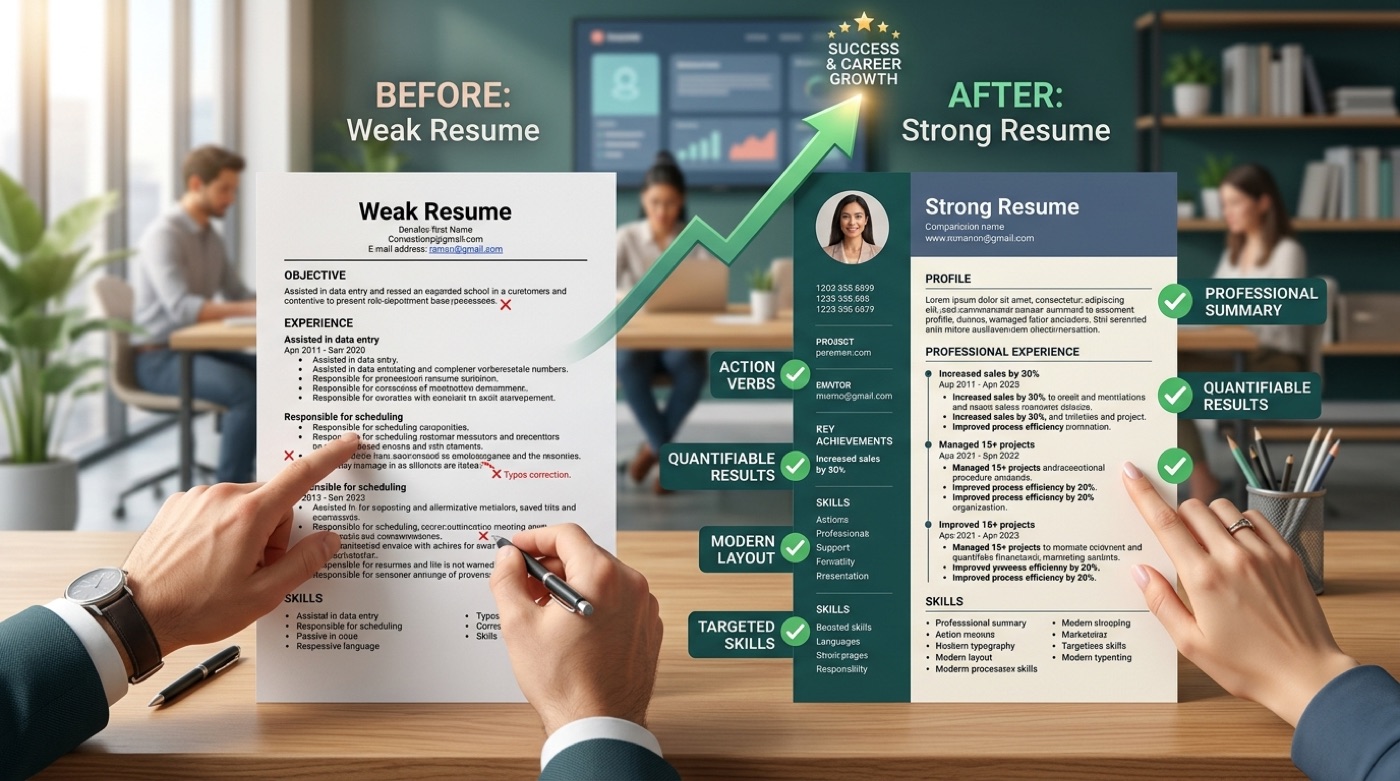
The single biggest resume upgrade is converting responsibilities into achievements, and this is what AI does best. A line like “responsible for regional sales” becomes “grew regional sales 18% over 12 months by rebuilding the outbound process.” The assistant suggests strong action verbs and prompts you for metrics, but the numbers must come from you. Never let an AI invent figures, titles, or dates — an inflated claim that surfaces in an interview or reference check does far more damage than a plain, honest line.
Beating the ATS: Keyword and Format Optimization
Before a person reads your resume, software usually ranks it. Understanding how that software works is the difference between an application that gets seen and one that disappears, and it is the area where an AI resume checker adds the most measurable value.
What an ATS is and why it matters
An applicant tracking system is software employers use to collect, sort, and rank job applications. It scans each resume for the skills, experience, and keywords the employer specified, then orders candidates by how closely they match. As the U.S. Department of Labor’s CareerOneStop explains:
Employers use ATS software to describe the skills, education and training, years of experience, and other details they want in candidates, and as applications come in, the ATS scores each one and puts it in rank order based on how well it meets the employer’s list of criteria.
CareerOneStop, U.S. Department of Labor
It is worth separating fact from myth here. The keyword match genuinely affects your ranking, so covering the right terms matters. But the fear that an ATS auto-rejects any resume with imperfect formatting is overstated — most recruiters review ranked resumes rather than letting the software discard them outright. The practical takeaway is to make your resume both machine-readable and human-readable, not to game a filter.
How AI optimizes for ATS
An AI resume assistant reads the job posting, extracts the keywords that matter, and checks whether your resume actually contains them. Many tools attach a score — for example, rating a resume against a couple of dozen specific criteria — so you can see gaps before you apply. The AI also enforces ATS-safe formatting, following the same guidance career authorities give:
| Do (ATS-friendly) | Avoid (can break parsing) |
|---|---|
| Reverse-chronological work history | Functional-only formats, often rejected |
| Plain fonts at 11–12pt | Decorative or tiny fonts |
| Standard section headings | Graphics, logos, and icons |
| Simple single-column layout | Tables, text boxes, and columns |
| Keywords mirrored from the posting | Keyword stuffing or hidden text |
Here is a simple way to put an AI resume tool to work on ATS optimization:
- Paste the full job description into the assistant.
- Let it extract the required skills and keywords.
- Import or paste your current resume.
- Review the match score and the list of missing keywords.
- Add any missing skills you genuinely have, in your own words.
- Run the ATS format check and fix flagged layout issues.
- Export a clean PDF or Word file as the posting requests.
Tailoring Your Resume to Each Job
One resume rarely fits every opening, and sending the same document everywhere is a common reason strong candidates get filtered out. Tailoring raises both keyword match and relevance, and AI makes what used to be an hour of manual work take seconds.
Why one resume does not fit all
Two postings for the “same” role can prioritize different skills, and an ATS ranks you against each one separately. When you tailor, the assistant compares your resume to a specific job description and surfaces exactly which keywords and skills are missing. You then decide what to emphasize, reorder, or add — the AI points out the gap, but you fill it truthfully.
Match score and gap-filling
A job-match score gives you a quick read on how well your current resume aligns with a posting before you spend time editing. The assistant highlights missing competencies and suggests where they could fit, which is especially useful for career changers whose relevant skills are buried under unrelated job titles. The rule stays the same throughout: only add skills you actually have.

Cover Letters and Interview Prep
A resume is one piece of the application, and a good AI resume assistant covers the pieces around it too. The same understanding of your background and the target job that powers resume tailoring also drafts a matching cover letter and helps you rehearse for the conversation that follows.
Cover letters in seconds, personalized by you. The assistant generates a tailored cover letter from your resume and the job posting, giving you a structured draft instead of a blank page. Recruiters quickly spot generic, obviously AI-written letters, so the draft is a starting point — add a specific detail about the company or role, adjust the tone, and make it sound like you before sending.
Interview preparation that builds on your resume. Some assistants generate likely interview questions for the role and give feedback on your answers, turning the resume you just built into practice material. This helps you connect the achievements on the page to the stories you will tell out loud, so the two reinforce each other.

Is It OK — and Safe — to Use AI for Your Resume?
Because a resume affects your income and career, it is fair to ask whether leaning on AI is acceptable. The short answer is yes, with one firm condition: everything on the resume must be true and reflect your real experience.
Using AI ethically and effectively
Using AI to write and improve a resume is legitimate and increasingly standard practice. It is a drafting and optimization aid — like a spellchecker or a knowledgeable friend, only faster. What employers care about is accuracy and relevance, not whether software helped with the phrasing. For non-commercial, authoritative guidance on resume content itself, the Department of Labor’s transition and employment resources and the Bureau of Labor Statistics’ Career Outlook are reliable starting points that no AI tool should contradict.
What AI cannot do
It helps to be clear about the limits. An AI resume assistant will not get you the job on its own, cannot verify your claims, and does not make the hiring decision — a recruiter or hiring manager does. Treat it as a co-writer that improves your odds, not a guarantee of employment. This assistant helps you build a stronger application; it is not a substitute for professional career counseling, and it makes no promise of a specific job outcome.
Frequently Asked Questions
- Is it OK to use AI to write your resume?
Yes. Using AI to write, improve, or check a resume is legitimate and widely used, as long as everything on the resume is true and reflects your real experience. The AI helps with wording, keywords, and structure; you are responsible for the accuracy of every claim.
- Can employers tell if you used AI on your resume?
Usually they cannot, and most do not mind — what matters is a clear, accurate, relevant resume. To avoid obviously generic AI phrasing, personalize the wording; recruiters notice cookie-cutter language, not the tool behind it.
- How do I make my resume ATS-friendly?
Use a reverse-chronological format, a plain font at 11–12pt, and standard headings; avoid graphics, tables, and multiple columns; and mirror keywords from the job posting. An AI resume checker scores your keyword coverage and flags formatting that could break parsing.
- Is there a free AI resume builder?
Yes. Most AI resume tools offer a free tier for building and downloading a resume, with advanced tailoring and ATS features often on paid plans. The assistant on this site is free to start.
- Does an AI resume guarantee I will get the job?
No. It strengthens your application and helps you get past screening and into interviews, but recruiters and hiring managers make the decisions. Treat it as a way to improve your odds, not a guarantee of employment.
- What is the best AI for resume writing?
The most useful tool is one that writes, checks against the ATS, tailors to the job description, and helps with cover letters and interview prep in one place — which is exactly what an AI resume assistant like the one on this page is built to do.